

OEM Medical Disposable Manifolds for Safe and Efficient Fluid Handling
2026-09-01
What if the weakest link in your fluid handling system isn't the pump or the tubing—but the manifold connecting them? For many medical facilities, the answer lies in switching to OEM medical disposable manifolds. These precision-engineered components offer a safer, more efficient way to manage fluids across a range of procedures, from diagnostics to critical care. But not every supplier delivers the same level of reliability or customization. That's where INT stands apart—combining advanced manufacturing with a deep understanding of clinical demands. In this post, we'll take a closer look at how the right disposable manifold can streamline your operations, reduce contamination risks, and keep every connection secure.
What Sets Medical-Grade Disposable Manifolds Apart from Standard Fluid Components
The distinction shows up long before packaging. A standard fluid component—say, a machined polycarbonate manifold or a set of push-to-connect fittings—is built for general purpose transfer, often without any documented control over extractables, leachables, or surface finish. Medical-grade disposable manifolds, by contrast, start with resins that have been tested to USP Class VI or ISO 10993 standards, and they are molded in cleanroom environments where particulate and endotoxin levels are actively monitored. That difference matters when the fluid path touches a patient, because even trace mold-release agents or lubricants left on an industrial part can trigger a reaction or interfere with a drug formulation.
Another gap is in how the flow path is designed. Off-the-shelf fluid components frequently have sharp internal corners, dead legs, and threaded connections that trap fluid and encourage biofilm formation. Medical manifolds are engineered to minimize hold-up volume and eliminate crevices where bacteria can lodge. You also get full lot traceability down to the resin batch and production date, which is not something you can pull from a bin of standard fittings. That traceability supports regulatory submissions and makes failure investigations far less painful.
Sterility and single-use economics separate the two worlds further. A reusable stainless steel manifold might perform fine for years, but it demands validated cleaning, sterilization, and maintenance cycles—plus the risk of cross-contamination between batches. A medical-grade disposable manifold arrives pre-sterilized, often with a certificate of sterility, and is discarded after one procedure. This removes cleaning validation from the user's workload and reduces the chance of a costly contamination recall. Standard fluid components are not sold with that accountability because they were never intended to face the same clinical consequences.
How Custom OEM Manifold Design Eliminates Leak Points and Improves Patient Safety
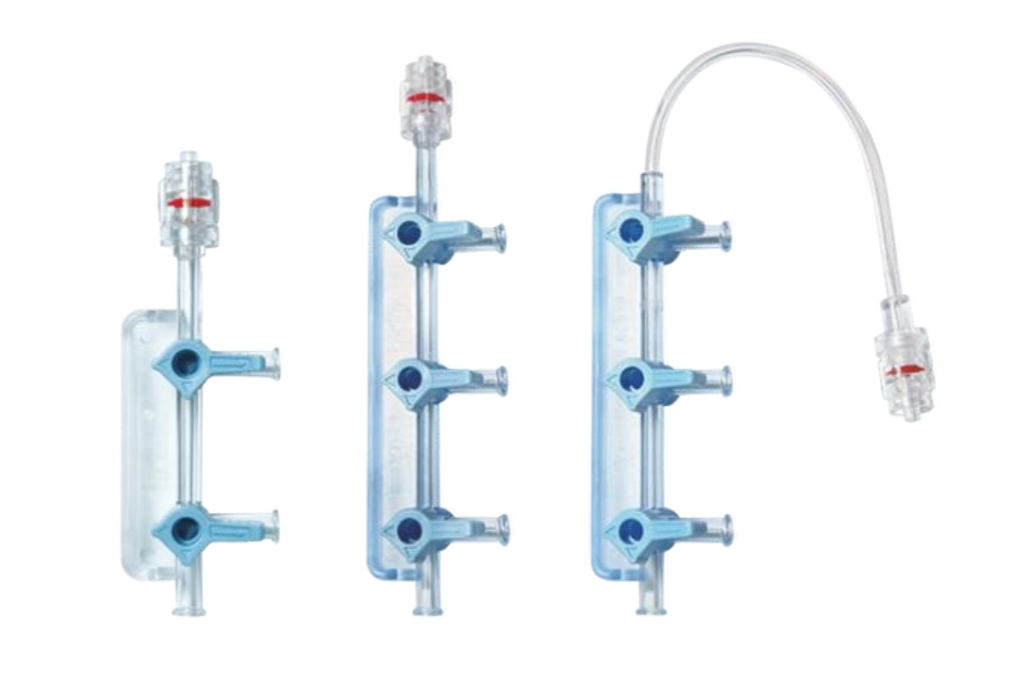
When a manifold is built to a device's exact specifications, the number of potential failure points drops dramatically. Standard off-the-shelf manifolds often force engineers to add adapters, extra fittings, and unnecessary junctions just to make connections line up. Each of those additions is a spot where a leak can develop under pressure or after repeated use. A custom OEM manifold does away with most of that by integrating the necessary ports, channels, and mounting features directly into a single block. Fewer separate pieces mean fewer seals to fail, which translates directly into a safer experience for the patient.
Beyond simply reducing the parts count, custom design allows for tighter control over internal geometries. For example, a manifold can be machined with smooth, gradual transitions between passages instead of sharp right angles that cause turbulence and stress. High-quality surface finishes and precise thread engagements further lower the risk of micro-leaks that might not be obvious during initial testing but can degrade over time. In critical care environments, even a tiny, slow leak in a gas or fluid delivery system can have serious consequences, so eliminating these hidden vulnerabilities is a major advantage.
Patient safety also improves because a custom manifold is often easier to assemble correctly. When the design is tailored to the device, there's less chance of a technician connecting the wrong line or overtightening a fitting to compensate for a poor match. Color-coded or uniquely keyed ports can be integrated into the manifold from the start, reducing user error. Ultimately, the shift from a general-purpose manifold to a custom OEM solution is not just about performance—it's about building reliability into the very foundation of the medical device.
Key Material Considerations for Disposable Manifolds in High-Flow Applications
When specifying disposable manifolds for high-flow processes, the first material property to scrutinize is creep resistance under sustained pressure. High linear velocities and abrupt pump strokes can generate pressure spikes that repeatedly stress fittings and tubing joints. Polypropylene and polyethylene are common choices due to their low extractables profile, but their creep behavior at elevated flow rates can lead to loosening over time if wall thickness is not increased or glass reinforcement is not used. In practice, many high-flow manifolds shift toward reinforced nylons or polycarbonate blends, accepting a slightly higher cost for dimensional stability that holds up across dozens of cycles.
Chemical compatibility cannot be treated as a static list of pass/fail solvents. At high flow rates, the fluid sweeps across a much larger surface area per minute, which can accelerate the leaching of antioxidants, slip agents, or residual monomers. A material that passes a 24-hour soak test may behave very differently under continuous turbulent flow. Look for materials that have been evaluated with dynamic extraction protocols, and pay attention to the surface finish—micro-roughness not only harbors bioburden but also creates micro-eddies that increase particle shedding from the polymer matrix.
Finally, assembly and sterilization methods heavily influence material choice. High-flow manifolds often use barbed or quick-connect fittings that require the polymer to deform slightly without cracking, so overly rigid materials can fail during installation. Gamma irradiation and autoclaving can both embrittle certain polymers over repeated cycles, which is a hidden risk when manifolds are reused within a campaign. A material that welds cleanly to tubing and creates minimal dead legs is non-negotiable, as any recess or step at a joint becomes a high-shear zone that can trap product or generate particulates once flow rates climb.
Why Pre-Assembled Manifold Systems Cut Down on Assembly Time and Error
Building a manifold on site means juggling a pile of fittings, nipples, valves, and sealant, then hoping every thread engages cleanly. A pre-assembled manifold removes that whole sequence. The factory has already mounted, torqued, and pressure-tested the valves, gauges, and ports as a single unit, so the installer only needs to land the block and connect the main lines. That one step replaces a dozen or more individual connections.
The error reduction is not just about speed. When threads are cut and sealed in the field, small mistakes compound quickly: a cross-threaded fitting, a forgotten O-ring, or an over-tightened joint can turn into a leak that requires draining the line and starting over. Pre-assembled units are sealed under controlled conditions with calibrated tools, which means those hidden failure points are largely designed out before the box even reaches the job site.
On top of that, the physical layout of a pre-assembled manifold is already optimized. Ports are spaced for wrench access, isolation valves are in logical order, and labeling is done at the factory. A technician no longer has to guess which port feeds which zone or spend ten minutes fitting a wrench into a cramped corner. The result is a faster start-up, fewer trips back to the supply house, and fewer leak calls after the system is live.
Designing for Low Dead Volume: Practical Benefits in Drug and Fluid Delivery
Low dead volume isn't just a spec sheet bullet point—it shows up in the everyday economics of infusion therapy. In a standard IV set, the space between the catheter hub and the injection port can trap 0.2 to 0.5 mL of fluid. For a drug like insulin or a pediatric antibiotic dosed at 10 mg per mL, that residual volume translates into real money and real dosage error. Designers who shrink these internal channels see immediate cost savings on high-value biologics, and nurses spend less time flushing lines to chase every last drop.
The patient-facing benefits go beyond cost. Consider oncology infusions, where a dead volume of just 0.3 mL can mean a 5% underdose for a small child. Low-dead-volume connectors and syringe tips ensure that what you draw is what you deliver—no hidden pockets where active ingredients linger. This becomes critical when switching between incompatible drugs in the same line; a smaller residual pool means less chance of precipitation or interaction, and fewer adverse events traced back to leftover fluid.
Maintenance and workflow also shift. A manifold with minimal dead volume doesn't demand aggressive saline flushes between each medication, which cuts setup time and reduces the risk of pushing air emboli into the patient. For home infusion pumps used with expensive enzyme replacement therapies, a low-dead-volume cassette can recover an extra dose per vial over a month—turning a design detail into a compliance and budget win for families managing chronic conditions.
Choosing the Right Bonding and Sterilization Methods for Single-Use Manifolds
Selecting the appropriate bonding technique for single-use manifolds shapes how the final assembly holds up under pressure and repeated handling. Solvent bonding works well for rigid thermoplastics when a clean, low-cost join is needed, but it demands tight control over dwell time and fixture alignment. For mixed-material or higher-strength applications, UV-curable adhesives offer faster processing and lower residual stress, while ultrasonic welding provides a completely dry, particle-free connection ideal for sensitive fluid paths.
Sterilization choices must match both the polymer chemistry and the bonded joint's thermal or chemical limits. Gamma irradiation penetrates sealed packaging effectively and suits many polycarbonate and polysulfone manifolds, yet it can embrittle certain acetals or cause discoloration in PVC. Ethylene oxide is gentler on temperature-sensitive plastics but requires longer aeration cycles to off-gas residues. Steam autoclaving remains an option for manifolds built from high-heat resins like PEEK or Radel, though repeated cycles can stress adhesive bonds and should be validated per lot.
A practical approach pairs the bonding method with the sterilization mode early in design. For a single-use bioreactor manifold using polyethylene tubing and polycarbonate connectors, ultrasonic welding plus gamma irradiation often yields the lowest failure rate. If the assembly includes check valves or elastomeric seals, EO sterilization may be safer to prevent elastomer cracking. Running small-batch compatibility tests under worst-case cycle parameters helps avoid late-stage redesigns and ensures the manifold functions reliably from fill to final disposal.
FAQ
They eliminate the risk of cross-contamination between procedures, reduce cleaning and validation burdens, and arrive sterile, ready to connect. Because each unit is used once and discarded, facilities avoid the unpredictable wear and degradation that can compromise reusable sets.
Yes. OEM production means the channel count, port sizes, tubing lengths, and bonding methods can be matched to your exact device architecture. We work from your drawings or help refine a concept so the manifold drops into your assembly without forcing design compromises.
Typical choices include medical-grade polycarbonate, acrylic, PVC, and polypropylene, often paired with silicone or PVC tubing. Selection depends on chemical compatibility, pressure exposure, and whether the fluid path needs to be visually inspected.
Each lot undergoes dimensional checks, leak testing, and visual inspection under controlled conditions. We also maintain full traceability from raw resin to finished manifold, with documentation that supports your regulatory file.
Many designs handle either, but the sealing method and material choice matter. For gas paths, we often recommend solvent bonding or ultrasonic welding to prevent microleaks; for liquids, barbed or luer connections may be more practical for quick assembly.
It varies by complexity and automation level, but a typical starting point is a few thousand units. For simpler configurations with standard components, lower volumes can sometimes be accommodated during pilot production.
They arrive pre-assembled and pre-tested, so staff spend less time on setup and sterilization. Integration of multiple channels into one compact block also reduces the number of fittings and potential leak points, speeding up changeovers between patients or experiments.
They are typically manufactured under ISO 13485 quality systems and can be supplied with documentation supporting biocompatibility per ISO 10993. Depending on the application, they may also need to meet USP Class VI or specific sterilization validation requirements.
Conclusion
Disposable manifolds built for medical OEM applications differ from off-the-shelf fluid components in several practical ways. They are manufactured with traceable, medical-grade resins and validated for biocompatibility, which becomes critical when a manifold sits directly in a patient line. Custom OEM design goes further by consolidating multiple tubing connections into a single bonded assembly, removing the joints that typically become leak points. Fewer connections mean fewer opportunities for contamination or air ingress, and that directly supports patient safety. In high-flow applications, material selection is driven by pressure tolerance, chemical compatibility, and resistance to particle shedding, not just raw cost, so the manifold maintains integrity under continuous load.
Pre-assembled manifolds reduce both assembly time and the chance of misconnection on the production floor, which is especially valuable in high-mix or low-volume manufacturing. Designing for low dead volume prevents drug or fluid from being trapped in unused branches, improving dose accuracy and reducing waste of costly biologics. Finally, the choice of bonding and sterilization method must align with the polymer and the intended use. Ultrasonic welding, solvent bonding, and adhesive joining each have different strengths and extractable profiles, while gamma, ethylene oxide, or electron beam sterilization must be validated to preserve sterility without degrading the material. These decisions collectively turn a simple fluid pathway into a safe, efficient single-use system.
Contact Us
Contact Person: Jeffrey
Email: [email protected]
Tel/WhatsApp: 86-0633-2230056
Website: https://www.sd-intmedical.com