

OEM HVAC Duct Protection Film Factory: What to Look for in a Quality Supplier
2026-05-28
When sourcing HVAC duct protection film from an OEM factory, the stakes are high—one wrong choice can lead to costly contamination, rework, or project delays. But with so many suppliers claiming top quality, how do you separate genuine expertise from empty promises? It starts with knowing what really matters in a production partner, and that's where Shire comes in—bringing clarity to the chaos with films engineered for real-world demands.
Material Mastery: Beyond Basic Adhesive Films
Adhesive films often get pigeonholed as simple sticky layers, but true material mastery starts when you stop treating them as commodities. The shift happens when you consider how the film’s backbone—whether it’s PET, polyimide, or a high-performance fluoropolymer—interacts with the adhesive chemistry under dynamic stress, thermal cycling, or chemical exposure. It’s about understanding that the carrier isn’t just a delivery mechanism; it actively participates in energy dissipation, dielectric performance, and dimensional stability. Engineers who dig deeper realize that a film’s surface energy, modulus, and viscoelastic response can be tuned to create bonds that go far beyond basic peel force.
Beyond the datasheet, real-world performance hinges on how these materials behave at the edges—literally. Edge lift, outgassing in vacuum environments, or creep under constant load can derail a design if the film isn’t matched to the substrate’s thermal expansion coefficient. Advanced users layer insight into converting techniques: laser kiss-cutting with zero kerf loss, rotary die-cutting that maintains adhesive integrity, or slitting tolerances that keep the release liner intact down to micron levels. They also leverage laminating strategies that embed functional additives—think conductive particles, flame-retardant fillers, or anti-static coatings—right into the film matrix, transforming a bond into a multifunctional interface.
This level of mastery also means embracing the lifecycle narrative. How does the adhesive evolve during cure cycles, humidity aging, or repeated sterilization? Mastery involves mapping these changes and designing for end-of-use scenarios, whether that’s clean removability for repair, recyclability, or permanent structural bonding that outlasts the product. It’s about recognizing that the best adhesive film isn’t the one with the highest initial tack, but the one that maintains a predictable, reliable connection throughout the entire application spectrum.
Custom-Fit Protection, Tailored to Exact Duct Specs
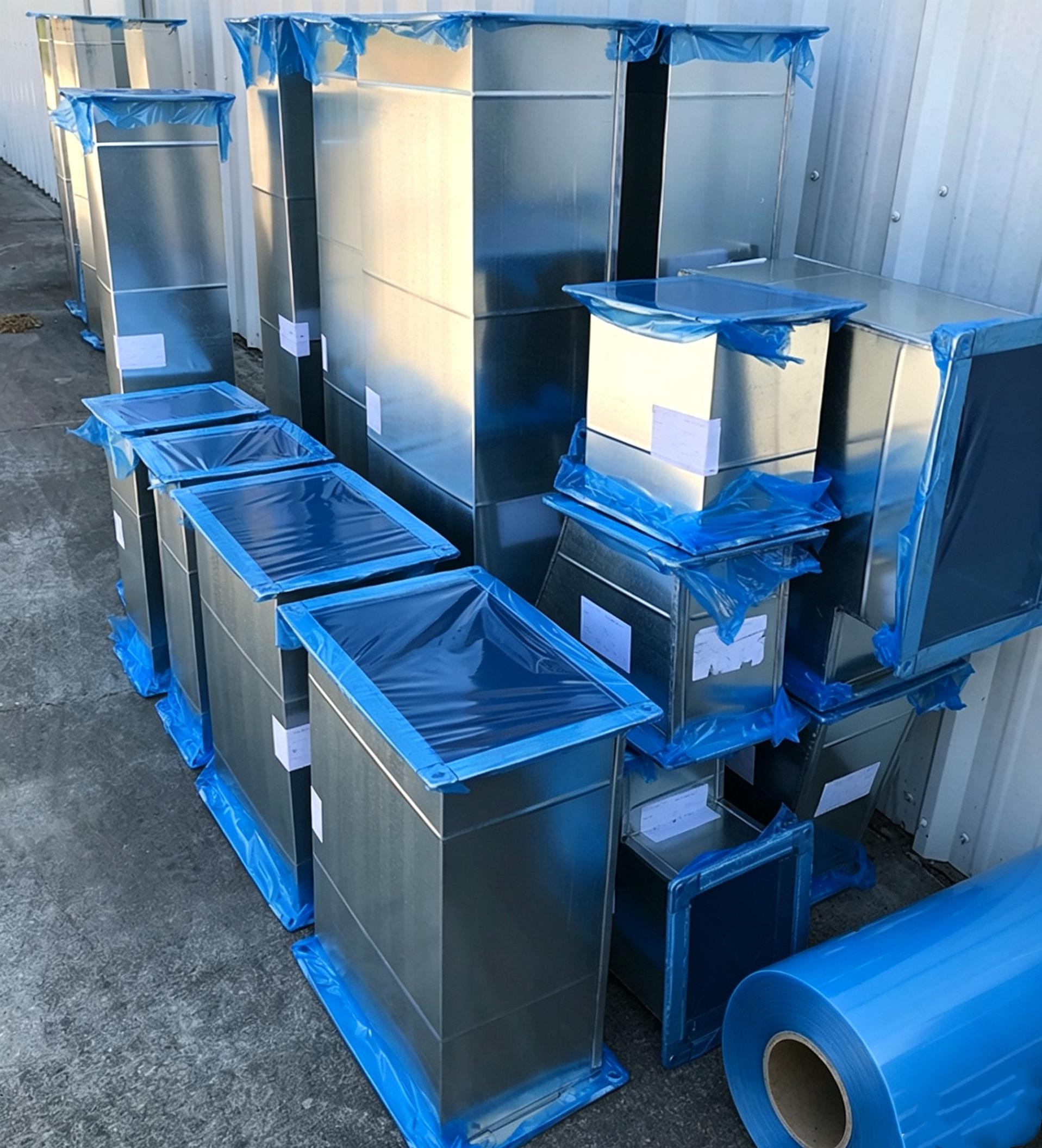
Every duct system has its own quirks—unique bends, diameters, and connection types that off-the-shelf covers simply can’t accommodate. That’s where custom-fit protection steps in, crafted to match your exact duct specifications without compromise. Instead of wrestling with generic sleeves that bunch up or leave gaps, you get a solution that mirrors the precise geometry of your ductwork, ensuring seamless coverage from end to end.
The process starts with detailed measurements and material selection based on the actual environment—whether it’s high heat, corrosive chemicals, or abrasive particles. Using these specs, each cover is fabricated to slip over flanges, wrap around joints, and hug contours tightly, eliminating weak points where wear typically begins. It’s not about trimming a standard product to make it work; it’s about building it right from the ground up for that specific run of duct.
The payoff is more than a neat installation. A cover that fits like a second skin stays put under vibration, resists snagging, and distributes stress evenly, so it lasts longer without maintenance headaches. You’re not just protecting ducts—you’re preserving the efficiency of the whole system, with fewer shutdowns and no more compromising on performance because the shield wasn’t quite right.
Rigorous Testing: The Unseen Backbone of Film Durability
Every frame of a movie owes its longevity to a brutal series of trials that audiences never witness. Long before a film ever hits the projector, reels are yanked, twisted, baked, and frozen in windowless labs. Technicians cycle samples through desert-level heat and artic cold, hunting for the faintest crack or emulsion lift. It’s a quiet, obsessive war against physical decay—one that determines whether a print survives its hundredth screening without a flicker.
The real artistry lies in the crossover between chemistry and punishment. Coating formulas get tweaked by fractions of a percent, then subjected to abrasive projectors that mimic decades of wear in a single afternoon. Scratch-resistant layers are tested with diamond-tipped styli, while humidity chambers force blistering and peeling to surface early. If a prototype can’t endure 5,000 simulated runs through a gate without shedding particles, it’s sent back to the bench—no matter how crisp the colors look.
What emerges from this gauntlet isn’t just a tougher film stock—it’s the invisible guardian of a director’s vision. When a classic revival plays without a hitch, or a festival print survives forty cities intact, it’s because someone, years earlier, decided to drown that exact formulation in salt fog and ultraviolet light until it confessed its breaking point. The projection booth may steal the spotlight, but the real backbone sits in the archive, silent and unbreakable.
Seamless Logistics: When Delays Aren’t an Option
In high-stakes industries where every minute counts, logistics isn't just about moving goods—it's about precision timing and absolute reliability. Medical devices, perishable foods, or critical manufacturing components can't afford to sit idle. A single delay can ripple into financial losses, compromised safety, or missed opportunities that no amount of apologies can fix. That's why our approach eliminates guesswork. We map out every variable from weather patterns to customs clearance, so your shipment doesn't just arrive—it arrives exactly when it matters most.
We built our network around redundancy and real-time adaptability. If a port congests, an alternate route kicks in before you even notice. Our ground teams don't just track packages; they actively solve problems on the fly, whether that means rerouting a truck mid-journey or hand-carrying a vital part onto the next available flight. It's not magic—it's meticulous planning paired with a refusal to accept "close enough" as a standard. That mindset has earned us the trust of surgeons, event producers, and factory managers who simply cannot hear the word "delay."
What truly sets us apart is that we act like an extension of your own team. You get direct access to logistics specialists who understand your business inside out, not just a tracking number. We anticipate seasonal surges, navigate sudden regulatory shifts, and even pre-position inventory based on your calendar. The result is a logistics partnership where seamless isn't a buzzword—it's the baseline. Because when the margin for error evaporates, you need more than a carrier; you need a guarantee.
Co-Engineering Support for Complex HVAC Applications
When standard HVAC solutions fall short in demanding environments, our co-engineering approach bridges the gap between concept and reality. We embed our thermal management expertise directly into your product development cycle, working side by side with your engineers to tackle unique airflow, filtration, and climate control challenges. This collaborative process uncovers hidden design constraints early, preventing costly redesigns and ensuring your system performs optimally under the most unpredictable conditions.
Unlike off-the-shelf components that force compromise, we tailor every aspect—from custom coil geometries to intelligent control algorithms—to match your exact operational profile. Our engineers bring decades of cross-industry insight, applying lessons learned from pharmaceutical cleanrooms to heavy industrial processes, giving your application an edge that generic support simply can’t offer.
The partnership extends beyond initial design through prototyping, validation, and production ramp-up. We maintain a rapid feedback loop, adjusting models in real time as test data rolls in, so your timelines stay intact. This hands-on collaboration doesn’t just solve the HVAC puzzle; it often reveals performance gains in other subsystems, turning a compliance requirement into a strategic advantage.
Transparent Pricing Without Hidden Cost Traps
Our pricing model is built on clarity and honesty. You’ll never encounter surprise fees, hidden add-ons, or ambiguous charges because we believe you deserve to know exactly what you’re paying for upfront. Every cost is laid out in plain language, allowing you to budget with confidence and focus on what truly matters—growing your business without financial uncertainty.
Unlike many providers that lure you in with low initial rates only to pile on unexpected costs later, we’ve stripped away the fine print. What you see in your quote is what you’ll be billed—no tricks, no traps. From setup to ongoing service, every expense is clearly itemized so there are no surprises down the road.
We’ve reimagined pricing to align with your success, not our bottom line. By eliminating hidden costs, we build trust that turns first-time clients into long-term partners. Transparent pricing isn’t just a policy for us—it’s a commitment to fair, straightforward business practices that respect your time and investment.
FAQ
Look for factories that can supply third-party test reports on adhesion strength, puncture resistance, and UV stability. Certifications like ISO 9001 or material-specific compliance with ASTM standards are also good signs they take quality seriously.
Ask about their adhesive technology—acrylic-based adhesives tend to perform better under temperature swings and dust. Request samples and test them on actual ductwork left outside for a few days. If the film curls or peels early, that's your red flag.
Residue usually comes from cheap adhesives or leaving the film on too long. A quality supplier will engineer the film with a clean-removal adhesive that's rated for the expected application window—often 30 to 60 days—and will back it with a warranty.
Custom printing turns your protection film into a moving billboard on site. But not all factories have the capability for high-resolution, abrasion-resistant printing. Ask to see print samples and make sure the ink won't transfer onto the duct surface over time.
A solid partner will help with inventory forecasting, offer just-in-time delivery options, and provide technical support if adhesion issues arise in the field. They should act like an extension of your team, not just a box shipper.
Yes, some factories now use water-based adhesives and recyclable film substrates that meet green building requirements. They perform comparably to traditional films, but you'll want to test them under your specific conditions to make sure there's no compromise in protection.
Conclusion
Finding a factory that truly understands OEM HVAC duct protection film goes far beyond just comparing adhesive specs. You need a supplier that treats material science as a living discipline, someone who sees polyethylene blends, tack levels, and UV stabilizers not as checkboxes but as levers to solve real on-site headaches. The best partners don't just offer off-the-shelf rolls—they walk your production floor, measure the exact duct profiles, and deliver film cut to shape so your installers aren't fighting wrinkles or trimming waste for hours. Behind that confidence is a regime of testing that never gets glamorous: accelerated weathering, tensile pull on hot metal, residue trials after extended sun exposure. When a factory does that obsessively, you feel it the first time you peel the film cleanly months later.
But durability and fit only matter if the product arrives when you need it. Quality suppliers run logistics like a surgical team—local distribution hubs, buffer stock programs, and real-time shipment tracking that actually works. They also know that HVAC systems rarely follow textbook designs, so they put engineers on your calls, not just sales reps, to work through odd geometries or high-temp exhaust runs. And when it comes to money, you can spot the dependable ones by how openly they break down costs: tooling, raw material surcharges, freight—no vague line items that balloon later. At its core, a great protection film factory earns trust through substance, not buzzwords, becoming an invisible but crucial part of your build quality.
Contact Us
Contact Person: Jack Xu
Email: [email protected]
Tel/WhatsApp: 8615257328825
Website: https://www.temporaryprotectivefilm.com/