

Custom Automatic Lathe Solutions for Precision Machining
2026-11-02
Precision machining demands more than just a capable lathe—it demands a solution tailored to your exact production challenges. At WINNRUI CNC, custom automatic lathe solutions are built around your parts, tolerances, and throughput goals, not the other way around. In this post, we’ll explore how engineered-to-order automation eliminates compromises and unlocks repeatable accuracy for complex workpieces.
Live Tooling Configurations Built Around Your Blueprint
Every setup starts with the actual blueprint, not a generic template. The system reads the dimensions, materials, and callouts directly from your drawing, then assembles the tooling arrangement to match those specifics. Nothing is forced into a preset mold, so what you see on screen reflects exactly what will happen on the floor.
Edits flow in real time. Change a tolerance or swap a component in the blueprint, and the tooling layout shifts accordingly—fixture positions, clamp types, and support points all update without rebuilding the scene from scratch. This keeps the configuration alive through revision cycles instead of turning it into a static snapshot.
Because the configuration stays tied to the blueprint, handoffs between design and production become smoother. Operators get a setup that already accounts for the latest drawing notes, reducing the usual back-and-forth and letting teams move straight into validation.
Bar Feeders and Gantry Loaders That Keep Spindles Turning
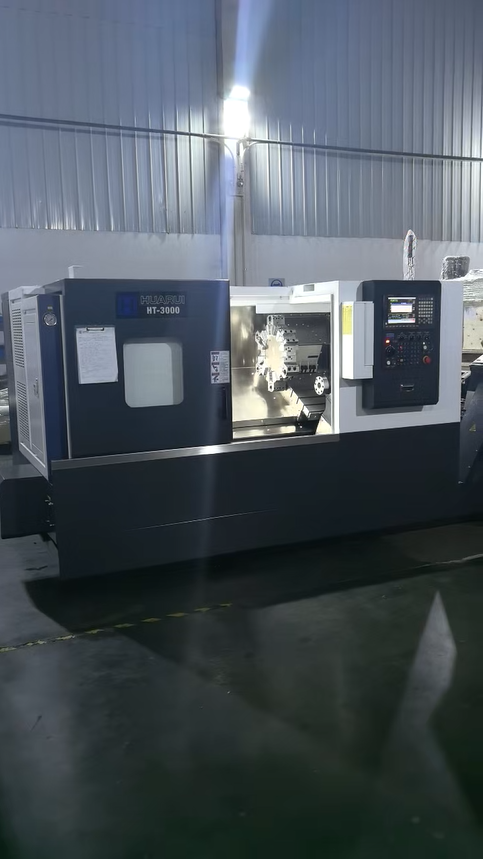
A spindle with nothing to chew on is just a very expensive paperweight. Bar feeders solve that by sliding stock forward in precise increments, so the lathe never waits for a human to fetch another length. The best ones adjust pressure on the fly—too much grip and you scar the material, too little and you get chatter that ruins a surface finish. Operators learn to trust the feeder's rhythm, listening for the soft thunk that means the next bar is seated and ready.
Gantry loaders take over where bar feeders leave off, especially for chunky billets or parts that need flipping between operations. These overhead arms swing in with a vacuum cup or two-finger gripper, drop the raw blank into the chuck, and whisk the finished piece to a conveyor without a coffee break. What separates a good setup from a great one is the small stuff: a loader that knows the difference between a wet part and a dry one, or a control that lets you jog the arm by hand when a chip gets wedged somewhere it shouldn't.
The real magic happens when the bar feeder and gantry loader talk to the machine tool instead of just reacting to it. You get lights-out runs where a magazine full of bars feeds the first operation, the gantry flips parts into the second spindle, and the whole cell keeps ticking until the raw stock runs dry. Shops that figure out this choreography stop thinking about cycle time per part and start thinking about parts per unattended hour—which is where the money actually hides.
Sub-Micron Repeatability Without Climate-Controlled Rooms
Achieving sub-micron repeatability used to mean isolating your equipment in a tightly controlled metrology lab. The assumption was that ambient temperature swings would inevitably warp frames, shift scales, and ruin measurements. But a different approach has emerged: instead of fighting the environment, you design the system to be thermally transparent. By pairing low-expansion ceramics with distributed temperature sensing, modern stages can correct for drift in real time, holding position to within a fraction of a micron even as the room cycles through several degrees.
The core idea is to treat thermal expansion not as noise but as a known, predictable signal. Every structural element gets a coefficient-of-thermal-expansion map, and a network of thermistors feeds live data into a firmware model that adjusts the commanded position on the fly. Symmetric layouts and short thermal loops reduce gradients, while passive heat spreading keeps hot spots from developing near the guideways. The result is that repeatability becomes a property of the control architecture, not the building's HVAC system.
For production engineers, this removes a major hidden cost. You can place a sub-micron-capable machine next to a loading dock or in a room with large windows and still get reliable results. Setup times drop because there's no need to wait for thermal stabilization, and recalibration becomes rare. That changes where precision automation can be installed—and how quickly a new line can start making good parts.
Tool Wear Compensation That Runs Unattended for Days
Most shops still rely on an operator to spot tool wear and nudge offsets, which means production stops the moment someone walks away. The real breakthrough comes when wear compensation is tied directly to spindle load and vibration signatures. The control watches those signals, compares them against a baseline cut, and adjusts the tool offset in tiny increments during the cycle. There is no pause for measurement, no waiting for a probe cycle, and no need to babysit the machine.
Once the system learns what a sharp tool feels like, it can track the gradual dulling across roughing and finishing passes. Wear compensation becomes a continuous loop rather than a scheduled check. If the spindle load creeps up beyond a set band, the control shifts the offset by a few microns and keeps cutting. If the signature shows chatter or rapid edge breakdown, it flags the tool for replacement before dimensions drift out of tolerance. This lets a batch run Friday evening through Monday morning without anyone touching a dial.
For long unattended stretches, the compensation logic has to be conservative but responsive. It should only change offsets when the evidence is clear, not on every minor fluctuation. The best setups combine load monitoring with periodic in-process probing to verify that the adjusted offsets are actually holding size. That way the machine can run lights-out for days, and the only reason to stop is when a tool genuinely reaches the end of its life, not because someone got nervous about a number on the screen.
Quick Changeovers for Families of Parts, Not Just Single SKUs
Most changeover improvement efforts focus on slashing the time it takes to switch from one specific part number to another. That mindset works fine when your production schedule repeats the same few SKUs in predictable batches. But real machine shops rarely run that way. You might move from a bracket family to a flange family, each containing a dozen variants that share similar jaws, tooling, and probing routines. Obsessing over single-SKU changeover times means you keep reinventing setups that are 90% identical. Instead, treat every family of parts as its own changeover entity. Group fixtures, tool holders, programs, and inspection references by family, not by individual part number. Then measure the total time to go from the last good piece of family A to the first good piece of family B, regardless of which specific members of each family are involved. This shift in perspective often reveals that most of your lost time isn't in the physical swap, it's in searching for the right collet, re-probing a stop that already existed for a sibling part, or editing a program because the tool offsets were saved under a different naming convention.
To make family-level changeovers stick, stop using generic setup carts and start building dedicated kits. For each part family, assemble a wheeled cart or shadow board containing the chuck jaws, soft jaws with pre-cut profiles, tool holders with measured lengths, dedicated stops, torque wrenches set to the right values, and even a laminated photo sheet showing the correct jaw orientation and probe points. The cart doesn't care which specific SKU you're running next, it only cares about the family. When an operator finishes the last flange of the day, they roll the flange cart away and bring in the bracket cart. Everything needed for the next family is already there, pre-set and pre-measured. This eliminates the single biggest hidden waste in changeovers: walking to the crib three times because you forgot a bushing or grabbed the wrong size pin. It also allows you to train new operators faster, since the cart itself acts as a visual standard for what a complete family setup looks like.
The payoff goes beyond just faster clock times. When you organize changeovers around families, you unlock flexible scheduling. You no longer need to run huge batches of one SKU to justify the setup effort. Instead, you can mix different members of the same family within a shift, because switching between siblings costs almost nothing once the family kit is in place. Customers get shorter lead times on low-volume variants without you eating extra setup cost. Your operators stop dreading the “weird part” orders, because the weird part shares 80% of its setup with the standard one they already know. And your continuous improvement efforts become more meaningful: tracking the changeover time from last-good-piece to first-good-piece across families reveals patterns that single-SKU metrics hide, like a persistent delay caused by a shared fixture that needs redesign. Focus on the family, not the part number, and changeovers stop being a bottleneck and start becoming a competitive advantage.
One Platform Handles Aluminum to Inconel Without Compromise
Switching between aluminum and Inconel on the same machine usually means accepting trade-offs in speed, surface finish, or tool life. This platform removes that compromise by integrating spindle torque curves, thermal compensation, and toolpath strategies that adapt to material density and work-hardening behavior in real time. The result is consistent chip evacuation and dimensional stability whether you are roughing a 6061 aerospace bracket or finishing a nickel-alloy turbine component.
Rather than forcing operators to maintain separate setups or swap out fixturing for harder alloys, the system's rigid base casting and active damping keep vibration low across the entire hardness spectrum. Programmers can use the same postprocessor for both material families because the control automatically adjusts acceleration and jerk limits based on the cutting load signature. This eliminates the need for conservative feedrate overrides that typically slow down aluminum jobs just to protect against the unknown demands of Inconel.
In practice, shops report fewer tool changes, less scrap from thermal drift, and the ability to mix materials within a single unattended run. The platform's built-in tool wear monitoring distinguishes between abrasive wear on aluminum and notch wear on Inconel, adjusting cutting parameters before catastrophic failure. That kind of material-agnostic intelligence turns a multi-material bottleneck into a straightforward, lights-out workflow.
FAQ
A custom build starts with your exact part geometry, tolerance stack, and production volume rather than forcing those into off-the-shelf travel limits and spindle speeds. You get things like a wider work envelope, tailored tool turret layout, or integrated part handling that are not practical to retrofit later.
It keeps the cutting zone thermally stable and reduces setup compromises. Custom fixtures, direct-drive spindles, and matched ball screws can be specified from day one, so the machine holds repeatable dimensions without relying on constant operator correction.
Most custom systems are designed around the metal families you actually run—hardened steels, aluminum, titanium, brass, or even brittle alloys. Chillers, spindle power curves, and chip evacuation are configured for those specific materials instead of a generic envelope.
Medical device makers, aerospace component suppliers, automotive parts manufacturers, and precision connector producers are common. Any sector where part tolerances are tight and order volumes are too high for manual loading but too specialized for a standard cell.
Yes. The integration scope can include robotic loading, conveyor interfaces, part probing, and even MES data handoff. The lathe is built around your current floor layout and operator workflow rather than making you redesign the line.
Bring full part drawings, tolerance studies, target cycle times, and a realistic volume forecast. Also note surface finish requirements, batch size variety, and any clean-room or chip-handling constraints. That lets the builder size spindles, tool stations, and automation correctly the first time.
It usually ranges from five to nine months depending on complexity, automation scope, and testing requirements. Pre-acceptance at the builder's facility and a detailed runoff with your actual parts tend to add two to four weeks, but they catch alignment and software issues before shipping.
Conclusion
Precision machining demands more than a standard automatic lathe—it requires a system shaped around the exact parts you produce, the tolerances you must hold, and the materials you cannot avoid. Our custom live tooling configurations start from your blueprint, not from a catalog of fixed options, so drilling, milling, and slotting operations happen in the same clamping without sacrificing rigidity. Add bar feeders or gantry loaders matched to your workpiece geometry, and the spindle keeps cutting through unattended shifts. The result is sub-micron repeatability on a shop floor that was never designed as a climate-controlled metrology lab, because the machine base, thermal compensation, and servo tuning work together to reject ambient drift instead of apologizing for it.
That same platform handles everything from free-machining aluminum to stubborn Inconel without forcing you to choose between speed and surface finish. Tool wear compensation runs for days without operator intervention, measuring cutting edges in-process and adjusting offsets before scrap appears. Changeovers between part families—not just single SKUs—take minutes because quick-change collet systems, preset tooling, and program templates treat your entire product range as one flexible cell. No exotic climate control, no dedicated operator babysitting each cycle, no compromise between material extremes. Just an automatic lathe built around your real work, so precision becomes routine rather than an achievement.
Contact Us
Contact Person: Tim
Email: [email protected]
Tel/WhatsApp: +86 15522553731
Website: https://www.winnrui-cnc.com/