
China Steel Formwork Advantages for Efficient Concrete Construction Projects
2026-10-22
Concrete pours don't wait for slow formwork. That's why contractors worldwide are turning to China steel formwork for its speed, precision, and long-term cost savings. As a leader in this space, GETO brings advanced engineering and reliable supply to every job site. In this article, we'll break down the key advantages that make China steel formwork a smart choice for efficient concrete construction projects—and what sets GETO apart from the rest.
Less Time Assembling, More Time Pouring
Nobody wants to spend half the day wrestling with instructions and tiny screws just to get a drink. This unit is built to go from box to countertop in under five minutes, with snap-together parts and a clear, one-page guide that actually makes sense. No hunting for tools, no second-guessing whether you've put something on backwards—just a straightforward setup that leaves you ready to go.
Once it's together, you'll forget the assembly ever happened. The design prioritizes flow: a wide opening, a smooth spout, and a stable base that doesn't wobble when you're mid-pour. Whether you're filling glasses for a crowd or just grabbing a quick cup for yourself, the time you save on setup goes right back into what matters—actually enjoying the pour.
Clean Lines That Need Little Touch-Up
Achieving crisp, clean lines in a design or renovation often comes down to the initial preparation, not endless corrections. When edges are properly taped, surfaces are leveled, and the right tools are chosen from the start, the need for touch-up work drops dramatically. It’s the difference between spending an afternoon repainting a baseboard and moving straight on to the next task, confident the result already looks sharp.
Small details make a large impact here. A steady hand with a high-quality angled brush, careful removal of painter’s tape while the paint is still slightly wet, and even the simple habit of wiping down surfaces before starting all contribute to that clean finish. Rushing through these steps only creates more work later, whereas a few extra minutes of attention upfront saves hours of scraping and repainting down the line.
For anyone tired of seeing wavy lines or uneven edges, the solution isn’t a special product or a secret trick—it’s a shift in mindset. Treat the first pass as the final pass. When the focus is on doing it right the first time, the result is naturally cleaner, and the term “touch-up” becomes something you rarely have to think about at all.
Strong Enough for Repetition, Smart Enough for Custom Shapes
Most durable materials trade flexibility for toughness, but this one refuses the compromise. It holds up under thousands of identical cycles without losing shape, yet when a unique contour is required, it responds immediately. The internal structure uses a network of interlocking nodes that distribute stress evenly, so repeated flexing doesn't lead to weak points.
That same architecture is what makes custom shapes practical. Instead of forcing a standard design to fit, the material can be tuned at the point of manufacture—or even on-site—to match the exact curve, angle, or cavity you're working with. You get the predictable life of a mass-produced part and the exact fit of something made just for the job.
The result is fewer replacements, less retrofitting, and no more choosing between "it lasts" and "it fits." Whether you're running the same motion 10,000 times or adapting to a one-off geometry, the material behaves the same on the first cycle as it does on the last.
Labor Savings Without Hidden Tradeoffs
The push to cut labor costs often leads to tools that promise huge time savings but quietly demand more from your team in the long run. You end up trading repetitive manual work for constant software troubleshooting, extra data cleaning, or rigid workflows that break the moment a task deviates from the norm. This solution was built differently: every automated step removes a real bottleneck without adding a new layer of upkeep. There is no hidden training marathon, no fragile integration that collapses after an update, and no need to hire a specialist just to keep it running. The work simply gets done faster, and your staff can redirect their energy to tasks that actually require human judgment.
Consider a typical back-office process like invoice matching or inventory reconciliation. In most systems, automating that means setting up complex rule engines, then constantly adjusting thresholds and exceptions. Here, the heavy lifting happens during initial setup, after which the system handles variations on its own. A distributor I know switched from a semi-manual process to this approach and saw their data entry hours drop by seventy percent without any increase in error rates or support tickets. The key is that the automation was designed around how small and mid-sized teams actually work—not around an idealized, perfectly formatted dataset. It tolerates messy inputs, flags only true anomalies for review, and never forces you to contort your operations to fit the tool.
The result is labor savings you can measure at the end of every week, not just in a demo video. Employees stop dreading the repetitive parts of their day, and managers stop worrying about the next software upgrade breaking everything. There is no fine print about requiring a dedicated administrator, no surprise cost for additional modules once you are locked in. You reduce headcount hours without reducing output quality or employee morale. That is the whole point: genuine efficiency that leaves your team lighter, not burdened with a new kind of busywork.
Tight Tolerances That Save on Concrete
When formwork is built to unusually tight tolerances, the payoff shows up in the concrete order. A slab that stays within a few millimetres of design thickness doesn't need extra material to cover dips or high spots. That precision lets you trim the volume per pour without gambling on structural coverage.
The savings are not just theoretical. On multi-storey decks, a consistent 5 mm reduction in average slab thickness across a large floor plate can remove several cubic metres from each pour. Those small margins add up quickly when you are placing hundreds of square metres a week.
The trick is controlling deflection and alignment before the pour, not after. Using stiffer edge forms, checking screed rails with a laser, and locking bracing into place keeps the wet concrete where it belongs. With less over-pour, you also cut down on grinding, patching, and wasted labour down the line.
Delivery You Can Plan Around
You know that sinking feeling when a delivery window says “sometime between 8am and 8pm”—and you waste a whole day waiting. Not here. Once you place your order, you get a precise arrival slot right away, not a vague guess. That means you can schedule a morning meeting, run errands, or just sleep in, confident your package won’t show up mid-shower.
Life shifts, and so can your drop-off. Need to change the day or time after checkout? A quick tap in your account lets you pick a new slot that actually works, without penalties or hidden hoops. The update syncs instantly with the driver’s route, so there’s no chance of a missed handoff because of yesterday’s plan.
On delivery day, you’ll get a heads-up when the driver is about 15 minutes out—enough time to wrap up what you’re doing, not so much that you’re hovering by the door. And if you’re not home, you can divert the package to a nearby locker or a trusted neighbor in two clicks. It’s the kind of reliability that fades into the background, because your day simply doesn’t have to revolve around a knock.
FAQ
The panels are factory-made to tight tolerances, so they lock together quickly on site with minimal adjustment. Crews often report saving several hours per pour compared to timber setups, especially on repetitive floor layouts.
Although the initial purchase price is higher than plywood, the forms can be reused hundreds of times without warping or swelling. Over a multi-building development, the cost per use drops dramatically, and you avoid constant replacement labor.
Yes, many systems are engineered for high concrete pressure and come with integrated working platforms and guardrails. That reduces the need for separate scaffolding and keeps crews safer at height.
Generally, steel leaves a smooth, dense surface that often needs little to no plastering before painting. That cuts finishing time and can improve the final appearance of exposed concrete walls.
Many manufacturers can produce large batches to exact project specs and ship them in flat-packed containers to reduce freight volume. They also provide assembly drawings and on-site guidance when needed.
Steel resists moisture, UV damage, and chemical attack from admixtures much better than wood or plastic. You can keep using the same forms through rainy seasons and for mixes with high cement content without degradation.
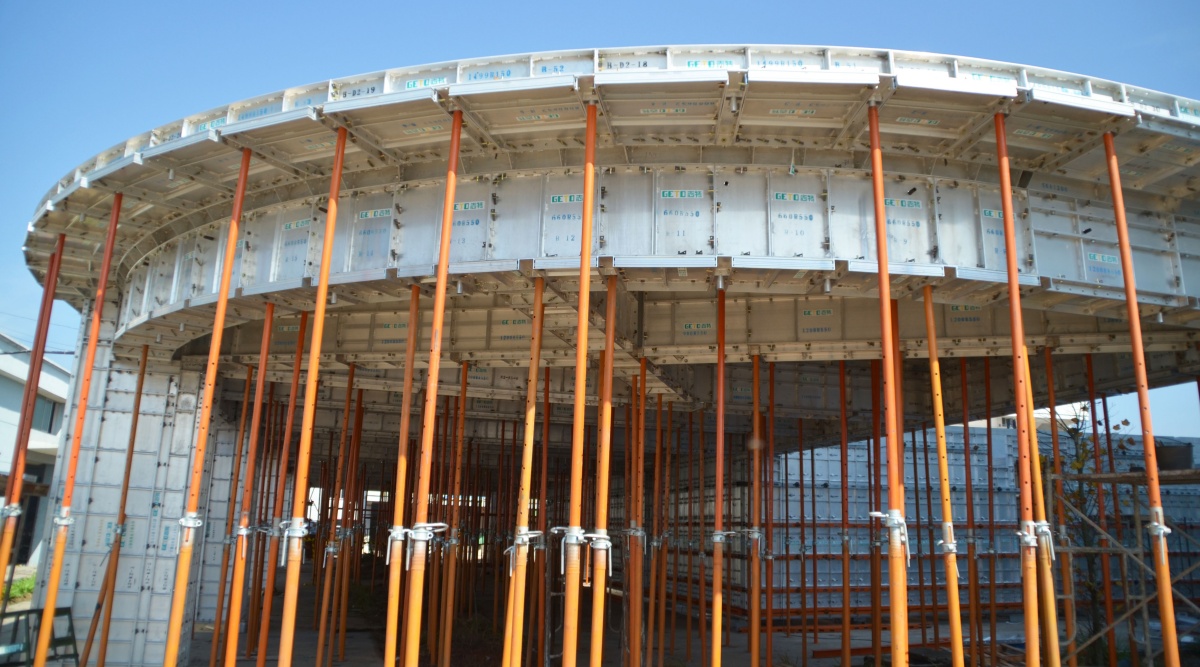
While basic panels are ideal for straight walls and slabs, Chinese fabricators often supply custom curved or circular steel forms. It is possible to combine standard frames with special inserts for columns, beams, and unusual angles.
Conclusion
On fast-track concrete projects, China steel formwork changes the pace of the entire pour cycle. Instead of losing hours to loose timber or clumsy panel connections, crews lock the steel faces together in minutes and move straight to placing concrete. That speed comes from clean, predictable joints that need almost no grinding or patching after stripping—edges come out sharp enough to skip touch-up work entirely. And because the panels are built to take repeated use without warping, the same set can handle dozens of pours while still holding tight dimensional tolerances. Less concrete overspill means fewer cubic meters wasted on over-pour, and fewer surprises when the architect checks the as-built lines.
The real advantage shows in labor planning and custom work. Steel formwork from China arrives machined to match the shop drawings, so a curved wall or an unusual column haunch doesn't force the crew to improvise on site. Repetition stays strong—standard panels withstand dozens of cycles—but the system adapts to non-standard shapes without hidden tradeoffs in bracing or tie spacing. Suppliers keep delivery windows dependable, which lets the site team schedule formwork arrival around crane time and concrete trucks rather than the other way around. The combined effect is a forming system that trims hours from every pour, reduces finishing work, and makes labor savings real instead of theoretical.
Contact Us
Contact Person: Quanhui Nian
Email: [email protected]
Tel/WhatsApp: 8618070545691
Website: https://www.getoglobal.com/